The Data Center Your Community Can Actually Own
While this was written for Michigan, we are also working in California. There is a quieter way to bring artificial intelligence to your town than the one making headlines. While the headlines describe hyperscale data centers the size of small cities — drinking down freshwater, straining local grids, and raising your neighbors’ electric bills — a different model is taking shape in church basements, library tech hubs, and net-zero housing developments. It runs on a stack of small machines, draws its power from the sun and the wind, and belongs to the people who use it. At podCOINai℠, helping communities build and own these Eco Mini Data Centers is what we do.
The problem with the giant in the next county
The current build-out of AI infrastructure is staggering in its appetite. Industry analyses estimate that AI systems alone could account for somewhere between 33 and 80 million tons of CO₂ emissions in 2025, with total AI power demand approaching 23 gigawatts — roughly the electricity needs of a country the size of the United Kingdom. The water numbers are harder still to absorb: AI data centers are on track to consume close to a trillion liters of water in 2025, about 264 billion gallons, equivalent to the annual water use of 1.8 million Americans. Much of that water is drawn from regions already under drought stress. In Texas alone, data centers are projected to use 49 billion gallons in 2025 and as much as 399 billion gallons by 2030.
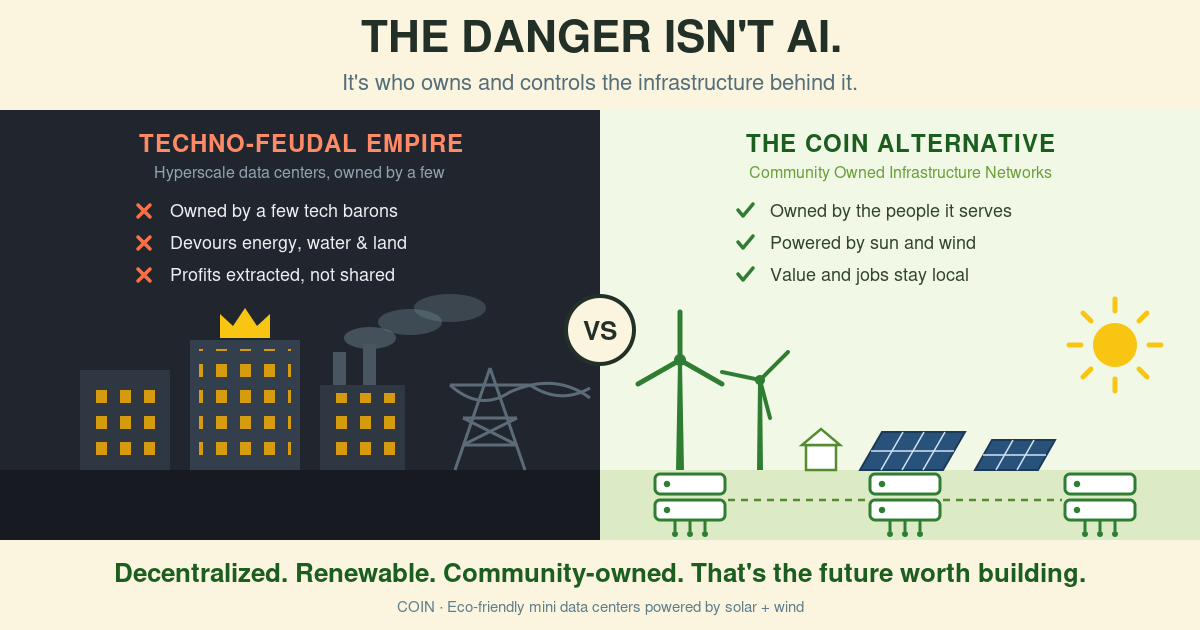
When one of these facilities is proposed near a small town, residents are often presented with a familiar bargain: a few dozen permanent jobs and some tax revenue in exchange for enormous, permanent draws on local water and power, higher utility rates for everyone connected to the same grid, and a sprawling private facility that the community will never own, never govern, and never benefit from beyond the lease. The intelligence it produces flows out to a corporation headquartered somewhere else. The environmental cost stays home.
It is worth saying plainly that hyperscale facilities are not useless — frontier AI models genuinely require concentrated compute, and someone has to run it. The honest question is not whether large data centers should exist at all, but whether every community’s AI needs must be met by renting capacity from them. For the vast majority of everyday work, the answer is no.
A different kind of machine
Most of the AI work a community actually needs — answering reference questions at the library, helping residents navigate government forms, drafting and summarizing documents, searching local records, supporting digital-literacy classes — does not require a hyperscale facility. It requires a capable computer that sits nearby, runs modern open-weight AI models, and keeps the work and the data inside the community.
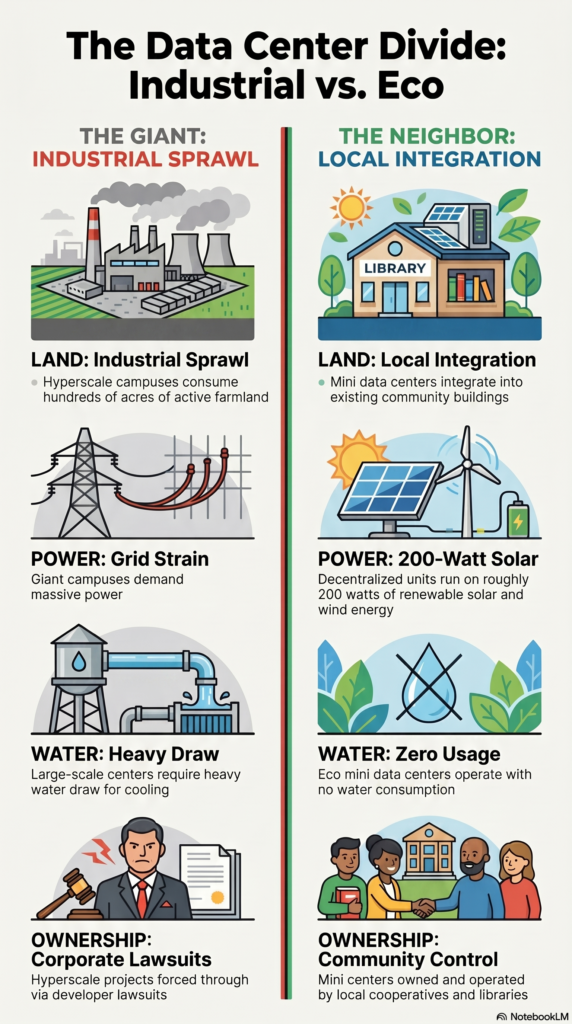
That is what an Eco Mini Data Center is. At its core is a stack of ASUS Ascent GX10 units — compact desktop machines, each carrying 128GB of unified memory, each drawing only about 200 watts under sustained load, roughly the appetite of a couple of household light bulbs rather than a city block. One unit handles a branch library. A small stack handles a housing development, a school, or a union hall. Because the GX10 sips power instead of gulping it, the entire system can be run from a modest renewable setup: a pair of solar panels, an honestly-rated wind turbine for the gray Michigan winters, a LiFePO4 battery bank to carry through the night, and transparent metering so the community can see exactly how much energy it generates and how much it uses. No new substation. No 49-billion-gallon water line. No surprise on the neighbors’ electric bill.
The contrast is the whole argument. A hyperscale campus externalizes its costs onto the surrounding community and exports the value. An Eco Mini Data Center internalizes the value — the capability, the savings, the jobs of running it — and keeps its footprint small enough that the community can actually carry it.
This is not a thought experiment
We design, supply, and support these systems — but the community-ownership model we build on is already working, proven by our affiliated nonprofit, the Broadband Institute Foundation (BIF, doing business as CommunityInternet). BIF helps communities build and manage their own broadband networks, keeping costs low and reinvesting the benefits locally, on the conviction that the internet should be a public commons — connecting communities the way a sidewalk connects a neighborhood.
The track record is concrete. Working with the Michigan network operator 123Net, BIF helped deliver free internet service to 50 affordable-housing units at the Veridian at County Farm net-zero development in Ann Arbor — advising the project on how to secure wholesale pricing by purchasing a single connection through homeowners-association fees. The estimated savings in electricity and internet for participating households comes to roughly $3,600 a year, money that stays in residents’ pockets for other essentials. BIF is also helping libraries stand up tech hubs and makerspaces, facilitated community workshops to help towns understand what a proposed data center would actually mean for them, and is preparing to launch coTutr, an AI-powered teach-the-teacher platform for communities building and governing their own digital ecosystems.
That is the same playbook, applied to compute instead of connectivity: listen to what a community needs, design a system that fits, train local residents to run it, and structure the ownership so the benefits compound locally. As Dr. Ron Suarez, BIF’s executive director, puts it, “Our work begins with listening. Every community has unique needs, and our role is to help them design solutions that fit their goals, train local residents to manage their networks, and strengthen digital equity from the ground up.”
Owning the infrastructure, not renting the intelligence
The financial case mirrors the environmental one. Cloud AI is rented intelligence: you pay per seat and per token, every month, forever, and the meter only ever runs up. For an organization that uses AI heavily, those subscription and usage fees become a permanent line item with no asset at the end of it. An Eco Mini Data Center is a one-time capital investment in hardware the community owns outright, powered by renewable energy the community generates, supported on a predictable plan. Over a few years, the math increasingly favors the community that owns its node over the one that rents its access — and the owned node keeps the data inside the building, which for a library’s patrons, a union’s members, or a housing co-op’s residents is worth as much as the savings.
This is what regenerative infrastructure looks like in practice: local, circular, and resilient. The energy is renewable and metered transparently. The hardware is owned, not rented. The skills to run it are taught to residents rather than imported. And the value — the capability, the cost savings, the dignity of self-determination — circulates within the community instead of being extracted from it.
Where to start
Building a community-owned Eco Mini Data Center is not a weekend project, and we would be doing a disservice to pretend otherwise. It takes a feasibility conversation about the community’s real AI needs, a power-system design honest about Michigan’s seasonal sun and wind, a plan for who maintains the system, and a governance structure for who decides how it is used. That is precisely the work podCOINai℠ and BIF do together — podCOINai supplying and supporting the technology, the nonprofit handling the training, the public programs, and the digital-equity mission, each kept properly separate.
If your town has been approached about hosting a hyperscale data center and you are weighing what that would really cost your community — or if you would simply rather own your infrastructure than rent it — that is the conversation worth having. The giant in the next county is one model for the AI era. A solar-powered stack of small machines that your community owns and runs is another. We think the second one is worth building.
We also began this white paper about Verdant Data Centers last year.
Sources:
- Broadband Institute Foundation — Affordable, Community-Owned Internet & Electricity Eco-solutions
- AI Data Centers’ Water Consumption Breaks 264 Billion Gallons in 2025 (Barchart)
- The carbon and water footprints of data centers and what this could mean for AI (ScienceDirect)
- AI Data Centers: Big Tech’s Impact on Electric Bills, Water, and More (Consumer Reports)