Expert Look at The Official ownAI Local First AI Agent
Most AI assistants live in someone else’s data center. Your questions, your files and the memory the assistant builds about you all sit on servers you don’t control. ownAI, a small open-source, local-first AI agent from Germany, takes the opposite approach. Its pitch is that your AI should belong to you, so it keeps your conversations and memory on your own device.
At podCOIN we spend a lot of time asking who owns the machines, the data and, eventually, the models that people depend on. So we took a close look at ownAI: what it does, who builds it, how it pays for itself, and where it fits alongside community-owned AI.
ownAI at a glance
- What it is: a free, open-source (MPL-2.0) personal AI agent for macOS, Windows, Linux, Android and iOS.
- What’s different: long-term memory that stays on your device, and an agent that writes its own small tools and reusable skills.
- Where the models run: on your own hardware, through your own Anthropic or OpenAI key or Ollama server, or through ownAI’s prepaid, Europe-hosted Credits.
- Who builds it: Jan Pawellek, an independent developer in Karlsruhe, Germany. We found no outside investors.
- Where it’s headed: from owning your data to owning your model, through AI that communities train together.
What ownAI does
Instead of a pile of separate chats, ownAI gives you one continuous conversation with an assistant that remembers. Its memory comes in layers: a short-term working memory, running summaries and a long-term searchable store, all kept in a single database file on your machine. You can also run several independent assistants, each with its own memory.
The more unusual feature is what ownAI calls self-programming. When the agent needs a capability it doesn’t have, it writes a small sandboxed program or mini-app, or a reusable skill in the open SKILL.md format. It also handles scheduled tasks, projects with access to folders you choose, PDF and Word attachments, and backups.
The examples on ownAI’s site are aimed at knowledge workers automating routine work, people building a personal knowledge base, and small businesses, including a café that uses it to prepare its weekly supplier order.
Three ways to run the models
ownAI keeps the app separate from the model, and that’s where its ownership story becomes practical. You choose how each assistant gets its intelligence:
- Fully local. Models run on your own computer or phone through llama.cpp, and nothing leaves your machine or network. The developer has shown a small Qwen3 model running on an iPhone in airplane mode, and the app checks what your device can handle before offering a model.
- Your own key or server. Connect your own Anthropic or OpenAI account, or your own Ollama server. Your prompts go to that provider directly, not through ownAI.
- ownAI Credits. One prepaid balance covers many models through ownAI’s own gateway, hosted in Europe. New accounts get a small free starter credit.
ownAI’s privacy policy is unusually plain-spoken. It names the companies involved (Hetzner in Germany for hosting, Scaleway in Paris and Infomaniak in Geneva for models, Stripe for payments) and says the site uses no advertising or tracking cookies. For Credits users, ownAI logs usage data such as the model, token counts and cost, and passes the prompt itself to the chosen provider. One gap: the iOS listing mentions a US processing region, and Credits also reach Anthropic and OpenAI models, but the public documents don’t say who processes those requests. If you plan to send sensitive material through Credits, ask ownAI first.
Encrypted sync
An optional paid service, ownAI Sync, keeps your devices in step with end-to-end encryption. Your data is locked on the device with a key derived from a passphrase the company never receives. The policy even admits what encryption can’t hide: unencrypted change timestamps show when you were active, though not what you did. The trade-off is real. Lose the passphrase, and your synced data can’t be recovered.
Who builds it, and how it pays for itself
ownAI is one person’s work. Jan Pawellek is a computational linguist with more than 20 years in AI and machine learning, now working independently and trading as ownAI in Karlsruhe. We found no investors, funding rounds or other team members. The project began in 2023–24 as a web platform for building your own AI. In early 2026 he rebuilt it from scratch as a cross-platform app written in Rust and TypeScript, and version 0.10.0 shipped on November 5, 2026.
The business model is simple:
- The app is free and open source, and running local models needs no account.
- Prepaid Credits carry a margin, part of which pays for carbon removal.
- ownAI Sync is a subscription with a free trial. Its price isn’t published.
- There’s no token, no crypto and no cooperative ownership structure.
The climate piece deserves credit. For Credits usage, ownAI estimates its emissions every day and buys at least that much permanent CO₂ removal through Ecologi, using biochar and enhanced rock weathering. It publishes its method and its receipts, which is more transparency than most AI companies offer.
The bigger idea: from owning your data to owning your model
ownAI’s mission line is blunt: “AI should belong to people, not corporations.” Its essays argue that keeping your data local is only half of ownership. Nearly everyone running local AI depends on open-weight models released by a handful of large organizations. If those releases stop, whether by corporate choice or government decree, the whole open ecosystem stalls. Pawellek’s answer is models that communities produce for themselves.
The plan he describes works like a guild. Associations, federations and networks of small businesses would jointly fine-tune open models. Each member trains on its own material on its own computer and shares only a compact mathematical summary a few megabytes in size, never the underlying data.
None of this is built yet. Today ownAI is a single-user app run by a sole trader, and there’s no governance structure behind its community-ownership language. But the direction is clear, and it’s the right question to be asking.
Traction and things to watch
ownAI is early and small. Its public code repository had only a handful of stars, the iOS app doesn’t yet have enough ratings to display a score, and we found no press coverage, named customers or user forum. Some AI-directory listings quote old prices that don’t match the current site, so check ownai.com directly.
Two more things are worth knowing before you build on it:
- It’s built with AI coding agents. In July 2026, members of Codeberg, the nonprofit code-hosting service, voted to ban projects written mostly by generative AI tools, citing unclear copyright status and weak safeguards against harmful code. ownAI said it is one of those projects and respects the decision, and on November 9, 2026 it moved its code to its own server at code.ownai.com. Some free-software users will treat an AI-written codebase as a reason for caution. Others will credit the project for being open about how it’s made.
- It depends on one person. That’s normal for young open-source projects, and the MPL-2.0 license keeps the code available whatever happens. Still, it matters if you plan to rely on the service.
How it compares
ownAI joins a growing field of open-source, local-first AI tools:
| Project | What it is | How ownAI differs |
|---|---|---|
| Jan | A popular open-source offline chat app | ownAI adds persistent memory, self-written tools and local models on phones |
| AnythingLLM | An open-source app for chatting with your documents | ownAI centers on an agent with memory rather than document search |
| Open WebUI + Ollama | A self-hosted web interface, often shared by a team or group | Open WebUI serves many users from one server; ownAI is one person per device |
| GPT4All, Msty, LM Studio | Apps for running models locally and chatting with them | ownAI is an agent layer that can use local or remote models |
| Goose, Leon, Khoj | Open-source local agents and “second brains” | The closest peers; ownAI adds encrypted sync, Europe-hosted credits, carbon accounting and the community-model vision |
What sets ownAI apart is the combination: a polished app on every major platform, a European privacy and climate posture, and a stated path from owning your data to owning your model. What holds it back is scale.
Not to be confused with
Several unrelated projects share the name, including ownai.io, a US consultancy that helps employee-owned companies adopt AI; ownai.systems, which sells preconfigured hardware for local AI; a company in India listed as ownAI on Crunchbase; and a separate iOS app called Own AI: Local LLM. There’s also a US trademark application for OWNAI, filed in February 2025, whose applicant we couldn’t identify.
What this means for community-owned AI
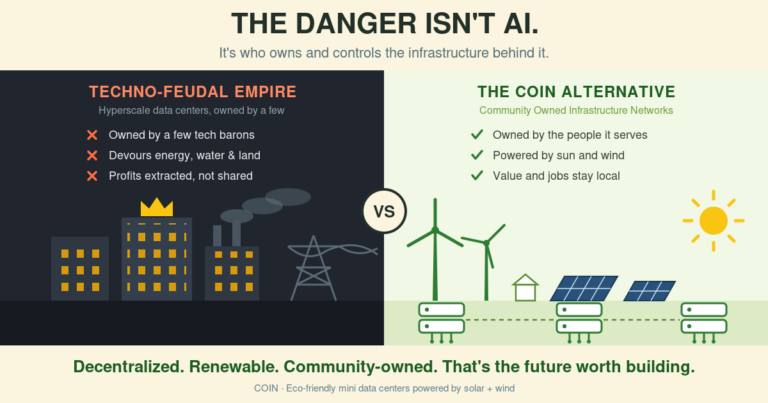
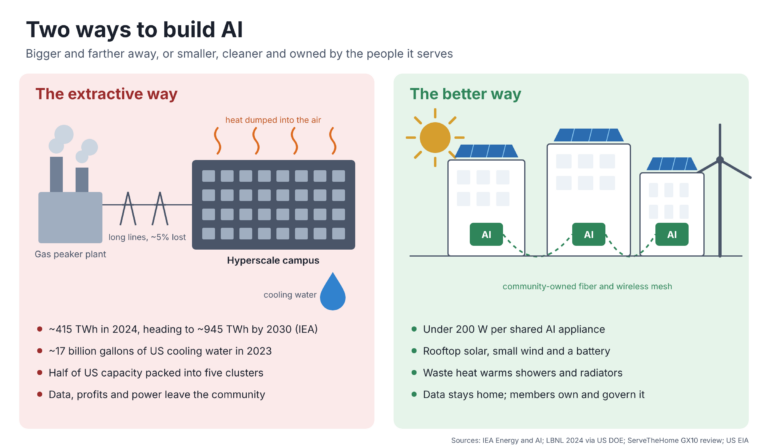
ownAI and podCOIN start from the same conviction: people should own their data, and eventually their AI. Where we differ is the unit of ownership. ownAI is built for one person on one device. podCOIN is built around shared hardware that a community owns and governs together, such as the solar-powered AI node in an apartment building we described in AI, The Better Way.
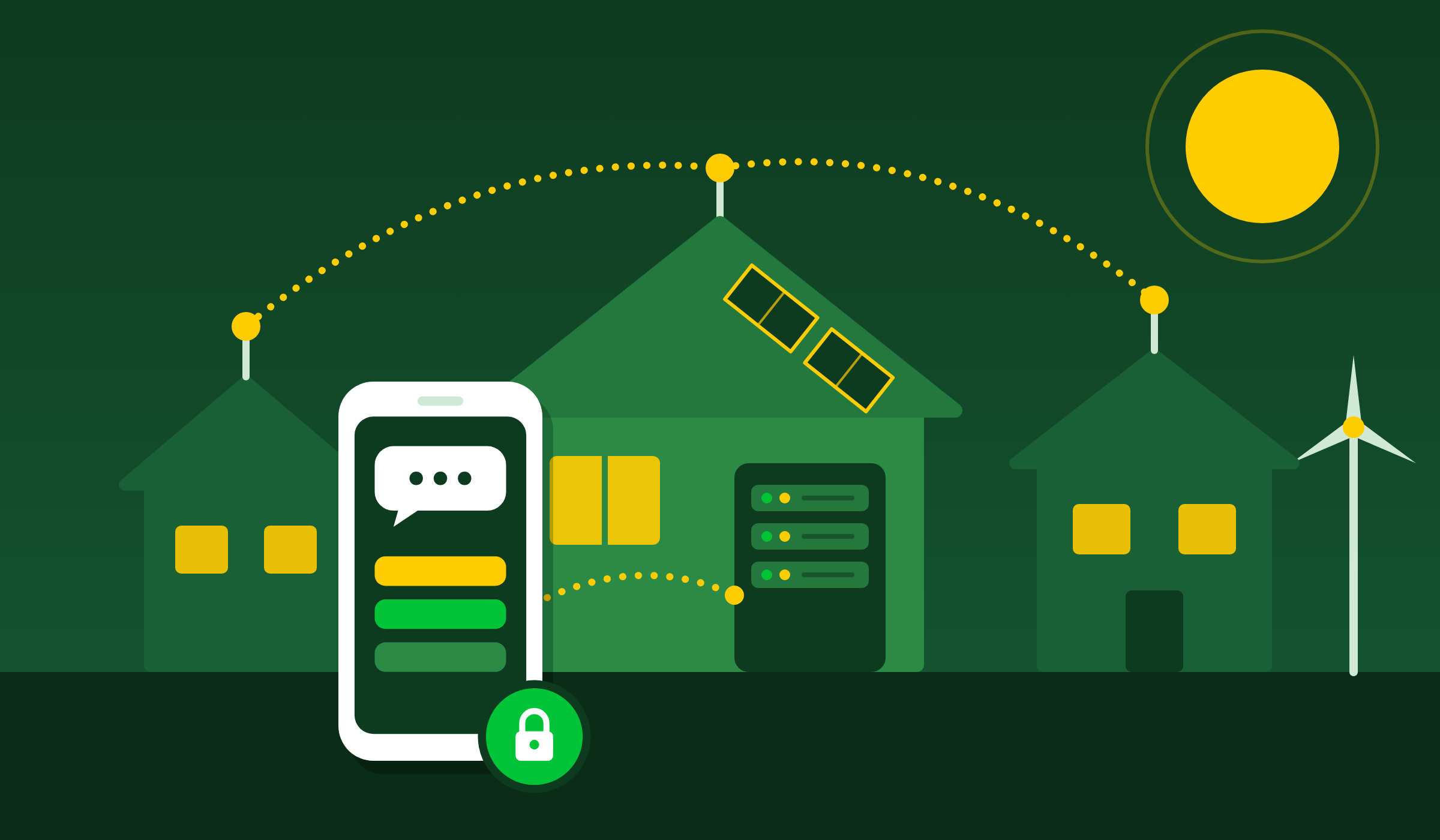
Those approaches fit together better than they compete. Because ownAI can already connect to an Ollama server, a member could in principle point their personal ownAI app at a community node and keep their prompts inside the community’s own network rather than sending them to a distant cloud. (We haven’t tested that setup yet.) And ownAI’s guild idea, where groups improve a model together without pooling their raw data, is exactly the kind of work that organized communities are well placed to do.
Some of ownAI’s habits are worth borrowing, too: publishing carbon-removal receipts, writing privacy policies that admit what metadata still leaks, and making documentation readable by AI agents as well as people.
If you care about who owns the AI you rely on, ownAI is worth a look. It’s free to download and can run entirely on your own machine. And if you’d rather own that AI together with your neighbors, join us at podCOIN.
Sources
- ownAI website
- ownAI privacy policy
- ownAI Library (manifesto and essays)
- What your AI costs the planet (ownAI)
- ownAI on the App Store
- ownAI’s archived Codeberg repository
- The Register’s report on Codeberg’s member vote, July 23, 2026
How we made this post: it was researched with the help of AI tools and edited by the podCOIN team. Details are current as of November 12, 2026. ownAI is changing quickly, so check ownai.com for the latest.